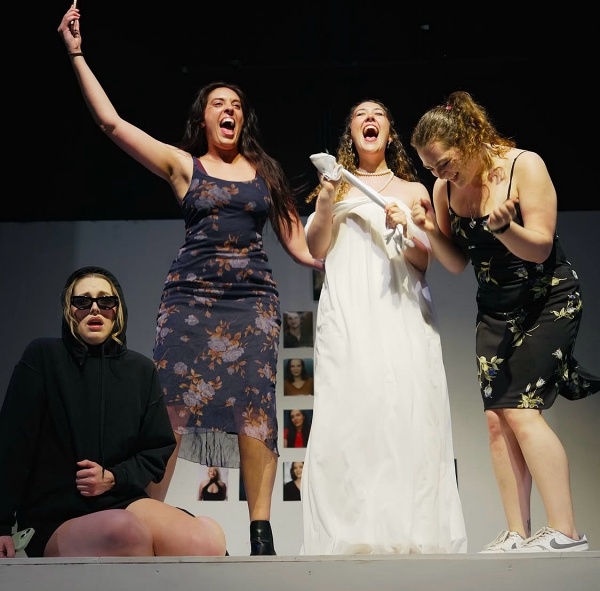
Anissa Naji is a German actress of Moroccan heritage, performing in five languages and based in New York City. A graduate of Circle in the Square Theatre School, her work spans Shakespeare, contemporary theatre, (musical) improv comedy and multilingual performances. Recent credits include off-broadway productions such as “Horse Girls” at Theatre Row, the Thank and the American theatre of Actors as well as at Westchester Theatre Collaborative and Improv Comedy nationally and internationally.
Fluent in Arabic, German, English, French, and Spanish, Naji’s artistic work is shaped by multilingualism, migration, and intercultural collaboration. In this interview, she reflects on performing Shakespeare as a non-native English speaker, navigating New York’s theatre landscape as an international artist, and the relationship between language, identity, and performance.
You work across classical theatre, contemporary plays, and new works development. What initially drew you to theatre as a performer?To tell stories from multiple perspectives. We can tell the same story, you and I, but it will always unfold in a different way because we bring our own experiences, knowledge, emotions, and points of view to it. Human beings and their stories inspire me—it’s what makes us vulnerable and what distinguishes us from other species.
Growing up while experiencing different forms of (structural) injustice, I always felt the need to speak up and use my voice in some way to create change. I love that, as myself, I don’t always feel powerful, but as Helena in Shakespeare for example, I feel like I have permission to take up space and speak up!
Shakespeare can already feel intimidating for many actors. What has your experience been navigating Shakespearean text as someone whose first language is not English?At first, I was very intimidated, especially because I was still struggling with my non-native accent. When you start learning or speaking a foreign language in a room where everyone else grew up with it, you often feel like you sound louder, “less clear,” or “less correct.” You become hyper-aware of your speech in a way others usually are not.
But in Shakespeare, suddenly everyone is “struggling” with the language. It felt like we were all in another kind of language class together, and that actually created a sense of equality. It strangely united us.
Did working on Shakespeare repertory at Theatre Row change the way you think about language or performance?Oh, definitely. Since it was my first Shakespeare piece done in English and (again) being the only non-native English speaker, it forced me to really know my words. That meant being one of the first people off-book so I could stop worrying about the language and focus on performance.
One thing I learned through working with director Mark Barford was how flexible and relevant Shakespeare can be today. We placed Much Ado About Nothing in a modern reality TV setting while still using the original text.
I also learned a lot about physicality in Shakespearean performance, especially through my work on characters like Conrade. Since I love physical comedy and physical acting, this helped me become more confident with Shakespeare and to make it more my own.
Apart from Classical work, you have also worked extensively on contemporary and developmental productions in New York’s independent theatre scene. What excites you about new writing and staged readings?Apart from bringing something that didn’t exist before to life, I love connecting with the people involved in the process. We all come from different stages in life, different jobs, and different daily realities—but when we enter the rehearsal room with the shared goal of creating something new, everything else falls away.
A new story is being told. A different perspective unfolds. A controversial idea appears. New words no one has spoken before come to life. That excites me.
I also find it to be a kind of “soft entry” into the industry, because people working on new work are often more open and generous with emerging artists. The mindset is more about “we are (still) learning here.”
Many of the productions you’ve been part of involve ensemble-driven storytelling. What do you enjoy about collaborative theatre-making?The power of community. Our imagination is fascinating, and it’s always incredible to see what happens when multiple minds come together to create.
Theatre is the only art form that cannot truly be done alone. You always need a crew, an audience, or even an imagined scene partner. That interconnection and constant exchange is what makes it so alive.
You have performed in productions ranging from dark comedy to psychological drama. Are there certain themes or emotional spaces you find yourself repeatedly drawn to as an actor?I’m very drawn to stories that explore human contradiction and emotional complexity. I love characters who are trying to belong somewhere, trying to express something they don’t fully know how to express, or who are navigating internal conflict.
I think that’s why I’m often drawn to dark comedy and psychologically layered work—because humor and pain are usually much closer to each other than we admit. I also enjoy work that allows emotional messiness to exist without immediately judging it.
In productions like Horse Girls or #ELeVeN, I was especially interested in the tension underneath the surface: what people hide, what they perform socially, and what eventually breaks through. I’m less interested in playing “likable” characters and more interested in playing truthful ones.
How has navigating different cultures and languages shaped your artistic identity in New York?It has shaped almost every aspect of how I approach performance. Growing up between cultures and languages taught me early on that communication is never just about words. Rhythm, silence, tone, body language, and cultural context all influence meaning. Multilingual people often become highly sensitive observers because we are constantly adapting to different environments.
In New York specifically, this becomes even more visible because the theatre scene is incredibly international, while many performance traditions are still rooted in American or English-language norms. Performing Shakespeare or contemporary American theatre as someone who did not grow up speaking English natively forces you to engage with text differently.
It can feel intimidating, but it can also become a strength because you approach language with a different level of awareness and precision. I also think moving between cultures has made me very collaborative as an artist. I’m curious about different perspectives and drawn to spaces where people from different backgrounds create together, rather than fitting into a single artistic identity.
New York theatre can be both exciting and overwhelming, especially for international artists. What has your experience been building a creative life there?I think both are true at the same time. New York can be incredibly inspiring because you are constantly surrounded by artists who are committed to their craft. There is always another reading, rehearsal, festival, devised piece, or independent production happening somewhere. I’ve learned it’s not just “a city that never sleeps”, but it’s a city where artists never sleep… That energy pushes you creatively.
At the same time, building a life here as an international artist can also be emotionally and financially exhausting. There is a constant negotiation between artistic passion, survival, immigration realities, and professional uncertainty.
Many international artists are building careers while also navigating visa processes, cultural adaptation, and the pressure to constantly prove themselves in a highly competitive environment.
But these challenges have also made me more resilient and more intentional about the kind of work I want to create. My experiences in New York’s independent theatre scene, especially in collaborative and ensemble-based spaces, have shown me that meaningful artistic communities can exist even in a city that can feel overwhelming.
Finally, what kinds of stories or artistic collaborations are you hoping to explore next?I’m especially interested in projects that bring together different cultural perspectives and theatrical traditions in a way that feels emotionally honest rather than performative.
I would love to continue working on new plays and collaborative theatre projects that explore identity, language, migration, and belonging without reducing people to stereotypes or political symbols.
I’m also increasingly interested in work that blends humor with emotional vulnerability. I think comedy can reach people in ways direct confrontation sometimes cannot.
Long-term, I would love to help create spaces where multilingual and international performers are not treated as exceptions, but as a natural and valuable part of contemporary theatre-making.
That´s beautiful, Anissa. One last question: How can people follow your journey? Thank you! People are welcome to follow my artistic journey on
Instagram, where I share updates on performances, theatre projects, and creative work in New York.