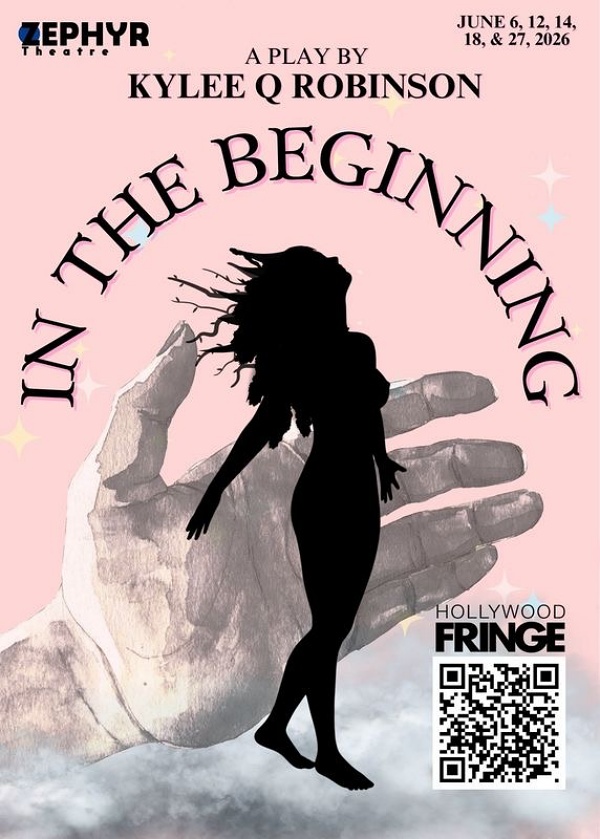
Italian actor Giorgio Rossini makes his Hollywood Fringe Festival debut in In the Beginning, a bold and unconventional new play by Kylee Q Robinson. Reimagining the story of Adam and Eve through a deeply human, comedic, and existential lens, the production places Rossini’s Adam at the center of love, conflict, and consequence. Here, Rossini reflects on stepping into such an iconic role and bringing it to life on stage alongside Laurel Preston as Eve and Landon Reid as God.
What drew you to ‘In the Beginning’ and the opportunity to play Adam? This is a story I learned from children’s books and stories, just like a fairytale, but with strong religious and moral connotations. Adam and Eve has always been an image, a painting, stuck I my head and immobile in time and space, like Michelangelo’s famous masterpiece. Seeing the casting call for this story I could not but respond to a call from the furthest corner in the back of my mind. Hesitant at first, the second I stepped onto the Zephyr theater for the in person audition, everything fell into place: the energy of Kylee from the very beginning, the Fringe Festival scene, my religious and artistic upbringing… even after 3 years away from the stage, I felt like I had never left.
Adam is one of the most recognizable figures in history. How did you approach making him feel human and relatable rather than symbolic? To be honest, the script itself did all the hard work for me. Even from my first read of the play, I realized that was indeed the strength of this project: taking a religious myth and putting it into human life. The symbolics given to us by religion and art alike become tools to use and dismantle, creating a process of humanization of these characters and trying to make it all make sense: the whys and the how’s, the reasons and the consequences, not as mere given facts, but rather as real lived people like us. This play is not about Adam and Eve, but rather Eve and Adam, a simple but revolutionary change of approach to the story with an immensely different outcome from the storybook story we all know.
This version of the story leans into humor, vulnerability, and even absurdity, how did you find the balance between comedy and emotional truth? The role of Adam in this play requires a lot of physicality, working as the comedic relief in a heavy themed play, brought mainly from Eve. However, he needs to be true to himself and his human male essence. Anger, jealousy, despair, responsibilities, fatherhood… it’s all part of who Adam is as a man and it gives Eve reason to be and to act. As an actor I let the comedic character come natural through movement, both in physicality and in vocality, and let the emotional character shine rather through stillness and composure.
Your character experiences love, anger, loss, and fatherhood all within the same story, what was the most challenging emotional beat for you to navigate? The aspect of Adam I had to work on the most, was his childishness and dumbness. Deconstructing the solid structural Adam as the first perfect man who was never a kid given to me by my education in church and school, and rather see him as a toddler, as a child, grumpy, crybaby, somewhat spoiled and kind of dumb. And along with that, letting the difference between Eden Paradise and Earth Desert be seen through a character change, rather than simple symbolism and indication. Adam’s overall arch is so complex that I had to break it down to more personal and human arcs that I can relate with. And as an almost 30 years old man, it took me some time to remember my own self in my first stages of life, how I acted and sounded and played when I was little.
The relationship between Adam and Eve is central to the play, how did you and Laurel Preston build that dynamic on stage? Laurel is a great actress I admired from the very first chemistry read we had and gave me so much to play with every rehearsal day, and I cannot wait to see where and how this will keep evolving and growing until performance day, in front of a live audience. During rehearsals we never really break character, even when receiving notes and blocking, playing off each other both from stereotypical differences of sexes, which Adam and Eve cannot but represent and embody, but also and more deeply from the human relationship between them. The playfulness of these roles is the core, the reason why this heavy play feels so true and real and very actual. We discovered and allowed ourselves to open up to one another, getting to know each other on a human level more than just an artistic one. Respect but interest, considering also both the metaphorical and the literal nudity aspect of the play.
The play explores big life themes, faith, purpose, grief, and choice, how did those themes resonate with you personally? Every human, by definition, experiences and is driven by big questions and life themes. As a believer myself I found it rather easy and natural to follow and incorporate my own human experience into Adam’s role. Questioning about why we’re here, why do we have to work hard and fatigue so much to keep alive, trusting and choosing: they all are daily thoughts in my mind and all I needed to do was reshaping them into the perspective of the man feeling them for the first time ever. Feelings of total loss, pure anger, responsibility and blaming, assessing and confronting them, rather than dismissing and silencing them. Giving voice to the human existentialism and realizing the only answer lays into something bigger than oneself.
With Landon Reid portraying God in such a bold and unconventional way, what was it like interacting within that dynamic? In 2026 it just makes sense for God to be a non-binary drag queen: neither male nor female, and both male and female, at the same time. Landon made it all the way even more real and God-like in a total and complete reproach of the classical representation of God as an old wise man. Their approach to the role in rehearsals made it so easy to connect with: a paternal figure, in their role as both caring and commanding father. It felt like being in a true relation with them rather following the structural Man-subjected-to-God schemes.
This production blends theatrical styles, from comedy to existential drama to physical storytelling, how did that influence your performance approach? After 3 years not playing on stage, but rather focusing on camera work, I allowed my artistic experience to blend both styles. My theatrical education, slapsticks and broad physicality, intersected with a more emotional and subtle cinematic truth. Studying in depth the script and Adam’s character gave me some clues of where it was needed a more energetic and bigger presence with the body, in contrast to other moments when a smaller body was needed to let the emotions explode and take over the stage in stillness and silence.
You have a strong background in both stage and screen, how does performing live at the Hollywood Fringe Festival compare for you? The Hollywood Fringe Festival is for me at this point of my career the perfect place to have fun with a bold character while being seen and appreciated by the audience. As an actor, I feel the stage gives me more satisfaction and a feeling of personal realization, and I am missing to hear and feed from a live audience reactions and energy. The sense of suspense, of relief, of awkwardness, until the final applause. Since my days at the American Academy of Dramatic Arts, I saw this theatrical festival as a strong and valid place to portrait my abilities as an actor. I witnesses classmates and friends experience and succeed in the Fringe Festival, and I felt this year was the perfect occasion and opportunity to close the circle of my education, and a way to open myself up to the real world of live theater, just like I had already done for camera work.
What do you hope audiences walk away feeling or questioning after seeing In the Beginning? My hope is that audiences will understand and connect with the story from a human and personal point of view, understanding that even legends and myths have something to teach us singularly. Masterpieces in film and television have done that for the Greeks and Romans, for Jesus and other major religious figures. Even Adam and Eve deserve to become human and personal, to teach us the real and true meaning of their story: every choice has a consequence, but it comes with its own reasons and a strong meaningfulness to it. Every action is itself a consequence of a previous state of being, as a change in something that was before. And bringing God into this scheme does have to be fearful and static but instead make it all make sense even more. God does not have to be immobile, and perfection doesn’t necessarily mean stillness and hierarchical obedience, but rather constant change in a true relationship one to one. Adam has his own relationship to Eve and to God, which is extremely different from Eve’ relationship to Adam and to God. That’s why their paths are extremely different and even contrasting, but in the end both of them found their peace and reason to be and live together with one another and with God.
With In the Beginning making its world premiere at the Hollywood Fringe Festival, Giorgio Rossini steps into a role that is both timeless and entirely reimagined, bringing a deep human perspective to one of history’s most iconic figures.
‘In the Beginning’ will play at the Zephyr Theatre in Hollywood, California from June 6 – 27. Tickets are available HERE. Mature audience is advised.